People rarely lose things because they don't own them. They lose them because they can't remember where they put them — and in a busy household, "where did we put it?" is a question with more than one person trying to answer it. That's exactly why so many families reach for Google Sheets. It's free, it lives in the cloud, and you can share one link so everyone sees the same list.
Google Sheets is a genuinely good starting point for a shared household inventory. But a shared spreadsheet and a tool built to find things are not the same thing, and the difference shows up the moment you're standing in the garage with your phone, not at a laptop. This guide compares using Google Sheets to track household items against LivingLedger, a home inventory app built around one job: helping you find things you already own by remembering exactly where you put them.
If you want the generic case for spreadsheets in general, the Excel comparison and the spreadsheet-vs-app overview cover that ground. This article focuses on what makes Google Sheets different — sharing and access — and where those strengths still leave gaps for a household inventory.
Quick answer
Choose Google Sheets if you want a free, shareable list multiple people can edit from any device, you value real-time collaboration, or your main goal is analysis you control.
Choose LivingLedger if your goal is simply finding household items quickly on your phone, remembering exactly where they are, and avoiding duplicate purchases — with far less upkeep to keep it current.
Who each tool is really for
Google Sheets is a free, cloud-based spreadsheet. Its defining trait isn't the grid — Excel has that too — it's that it lives online and is built for sharing. Anyone with the link can view or edit, changes appear in real time, and it works in any browser on any device. For a household where more than one person adds and looks things up, that shared, always-in-sync quality is the real draw. Sheets also succeeds because almost everyone already knows how to use it — a household can start organizing immediately, with nothing to install, no new system to learn, and no extra subscription. The trade-off is that a spreadsheet remains a blank canvas: the household has to design, maintain, and police the organization system itself.
LivingLedger is purpose-built to remember what you own and where it is. You add an item, tag where you put it, and later search the item's name to see its location. It's designed for busy households, for reducing mental load, and for the moment you actually need an answer — usually on your phone, away from a desk. It works as a native iOS app and as a web app in modern browsers.
Neither is better in the abstract. They're built for different jobs: Google Sheets answers "What do we own together?" — a shared, editable snapshot the household maintains together. LivingLedger answers "Where did we put it?" — a searchable answer on someone's phone the moment the question comes up. Here's the honest comparison.
Google Sheets vs LivingLedger: side-by-side
| What matters | Google Sheets | LivingLedger |
|---|---|---|
| Cost | Free with a Google account | Free plan available. Pro unlocks unlimited AI scanning for personal household use, subject to fair-use limits. |
| Sharing with the household | Excellent — one link, real-time | Shared, with a consistent structure |
| Works on any device | Yes, in any browser | iOS app and web app |
| Adding items | Manual typing, row by row | Type, or capture with a photo |
| Photos | Awkward to embed | Built in, one per item |
| Finding a specific item | Ctrl+F or filter | Search by name on your phone |
| Locations | Only if you build and maintain the column | Central to every item |
| Mobile editing | Possible, but cramped in the app | Designed mobile-first |
| Keeping it current | Depends on everyone's discipline | Lower effort to keep updated |
| Version history | Yes — see who changed what | Simple, consistent edits |
| Analysis and totals | Excellent | Limited |
| Best at | A shared, editable list you control | Finding everyday items fast |
Why people start with Google Sheets
It earns its place as a first choice, especially for households. The strengths are real:
- It's free for everyone. Anyone with a Google account can use it at no cost, with nothing to install.
- Sharing is effortless. One link, and the whole household is looking at the same list. This is the single biggest reason families pick Sheets over a desktop spreadsheet.
- It's cloud-first and always in sync. Edits save automatically and appear for everyone in real time. There's no "which copy is current?" confusion.
- It works on any device. Phone, tablet, laptop, someone else's computer — if there's a browser, you're in.
- Version history is built in. You can see what changed and roll back, which is reassuring when several people edit the same sheet.
- It's excellent for analysis. If you also want to total the value of what you own or build an insurance schedule, Sheets does the math beautifully.
For a household that wants a shared, free, collaborative list — and will keep it up — Google Sheets is a perfectly reasonable home inventory.
How to set up a shared household inventory in Google Sheets
If Sheets is your tool, a little structure up front makes the shared version work far better:
- Create one source of truth. Make a single sheet, name it clearly, and share the link with everyone in the house. Resist the urge to let people keep personal copies — that's how a household ends up with three conflicting lists.
- Agree on columns together. Item, location, and notes will carry you a long way. Add value or purchase date only if someone will actually use them.
- Set edit permissions deliberately. Give household members edit access; keep it link-restricted so it's not public. Decide whether kids get view-only.
- Standardize how everyone writes locations. This is the make-or-break step for a shared sheet (more on it below).
- Pin it where people will open it. Star it in Drive and add the mobile app to home screens, or the sheet quietly stops being checked.
For the deeper "what to include and how to build it well" guidance, the Excel comparison goes step by step — the structure principles are the same in either spreadsheet.
Keeping a shared sheet from drifting
A shared spreadsheet adds a failure mode a solo one doesn't have: different people record things differently. One person writes "garage," another "Garage shelf," a third "metal shelves by the door." All three describe the same real-world location, but a spreadsheet has no way to know that — they don't sort together, they don't search together, and unless the household actively enforces a naming rule, within a month the sheet is hard to trust.
To keep a household sheet usable:
- Write down the location naming rule at the top of the sheet — for example, Room → Zone → Container — so everyone follows it.
- Use data validation (dropdowns) for rooms so people pick from a list instead of free-typing. It's the closest Sheets gets to enforcing consistency.
- Decide who owns cleanup. Shared sheets need an occasional tidy, and "everyone" usually means "no one."
This is solvable, but it's ongoing work — and it's work that exists precisely because the tool is a flexible grid rather than a structured inventory.
Where Google Sheets begins to fall apart for household inventory
The trouble usually isn't that Sheets can't hold the data. It's that the job of finding things quietly stops getting done:
- Manual entry is slow, so it gets abandoned. Typing every item, row by row, across a whole household is tedious. The initial burst of effort fades, and an inventory no one updates can't tell you where anything is.
- It goes stale the moment something moves. Shuffle a bin from the closet to the garage and the sheet is wrong, with no nudge to fix it — and in a shared sheet, you may not even know who moved it.
- Mobile editing is cramped. Sheets opens on a phone, but pinching around tiny cells to add or update an item is enough friction that people don't do it in the moment. Picture standing in the paint aisle at Home Depot trying to check a spreadsheet to see if you already own a roller — most people just buy another one.
- Locations are an afterthought. Sheets only remembers where things are if someone built a location column and everyone fills it in, specifically and consistently. Usually they don't.
- Photos are clumsy. You can embed images in cells, but it's awkward, bloats the file, and rarely stays tidy.
None of this makes Google Sheets a bad tool. It makes it a flexible list that rewards collective discipline — and collective discipline is hard to sustain.
Common mistakes when tracking household items
These apply in any tool, and avoiding them matters more than the tool itself:
- Trying to inventory the whole house at once — the fastest road to burnout. Start with a shelf or the twenty things you always hunt for.
- Vague locations — "basement" isn't findable; if a guest couldn't locate it from your note, it's too vague.
- Letting it go stale — a list you don't trust is a list you stop checking.
- Choosing a tool that isn't with you when you need it — the answer is needed in a store or a closet, phone in hand, not at a desk later.
- Over-engineering — every extra column raises the cost of adding an item, and high cost is what kills the habit.
The genuine strengths of LivingLedger
LivingLedger is narrower than Google Sheets on purpose. It doesn't try to be a shared workspace or a calculator. It tries to make sure that when you need something, you can find it. The value shows up in outcomes, not features.
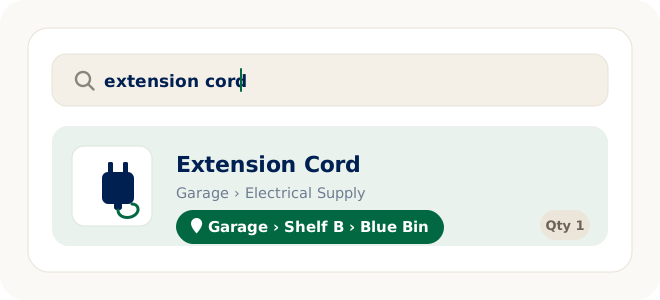
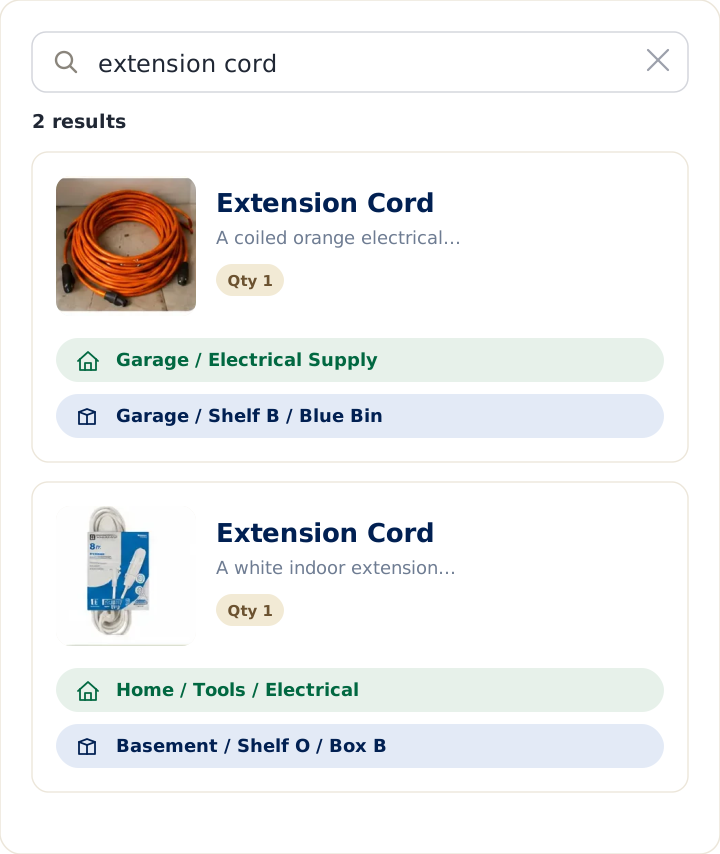
- A searchable memory for your home. Instead of remembering where the extension cord is, you remember that LivingLedger knows. Type "extension cord," see "Garage → Shelf B," and go straight to it. You search the item, not the box.
- Exact storage locations, not vague ones. Locations nest up to three levels deep, so the answer is precise enough to walk to — and because the structure is built in, everyone in the household records them the same way without having to agree on a convention first.
- Adding items takes seconds. Type an item in, or take a photo and let the app suggest what it sees. One AI photo scan can identify up to 10 items at once — a shelf, a drawer, a bin, a cabinet, or a single object — and you review what it finds, adjust anything, and save. The free plan includes 50 lifetime AI scan credits, with one credit per photo scan, and manual entry is always unlimited.
- It reduces mental load. You stop carrying the map of your whole house in your head. That matters for busy households and is part of why LivingLedger works well for ADHD-friendly organization.
- It helps you avoid buying duplicates. Because search lives on your phone, you can check before you buy.
- It stays usable as it grows. Search keeps the list manageable whether it's one closet or a whole home — you don't scroll, you ask.
The goal isn't to build a perfect catalog of everything you own. It's to stop losing Saturday afternoons opening every storage bin looking for one thing you know you bought.
Who should keep using Google Sheets
Be honest about how your household works. Google Sheets is the better choice if:
- Multiple people need to edit and view the same list, and you value real-time collaboration above all.
- Your main goal is analysis — totals, insurance schedules, calculations.
- You want a free tool that needs no install and works on any device with a browser.
- You like building and maintaining your own structure, and someone will keep it tidy.
- You want a file you control, with version history and your own sharing rules.
- You already have a shared sheet that works for your family. If it's working, keep it.
For collaborative, analysis-minded households that stay disciplined, a shared Google Sheet is a respectable home inventory.
Who is likely happier with LivingLedger
LivingLedger is probably the better fit if:
- Your real problem is finding things, not analyzing them — you own it, you just can't remember where it is.
- You've started a shared sheet and watched it drift or go stale because keeping it current was too much work for too many people.
- You want answers on your phone, in the moment, without pinching around a spreadsheet.
- You want consistent locations automatically, instead of policing how everyone in the house writes them.
- You're tired of buying duplicates, and you want to reduce the mental load of remembering where everything lives.
If "I know we have one, I just can't find it" is a regular sentence in your home, that's the problem LivingLedger is built to end.
A note on cost and availability
Google Sheets is free with any Google account and works in any modern browser. LivingLedger has a free plan with unlimited manual items and 50 lifetime AI scan credits, so you can track your whole home by hand at no cost and use photo scanning when it saves time. Pro adds more AI photo scanning — see the pricing page for current plans and prices. Your saved items stay available even if you move off Pro. LivingLedger is available as a native iOS app through the Apple App Store and as a web app in modern browsers, including iOS Safari, Android Chrome, and desktop Chrome and Edge. Accounts and photos are protected with Firebase Authentication and App Check. Self-serve export is on the roadmap; for now, export is handled by request.
Frequently asked questions
Can I use Google Sheets as a home inventory?
Yes. Google Sheets works well as a household inventory, especially when several people need to see and edit the same list. Build columns for the item, its location, and notes, share the link with your household, and keep it current. The catch is upkeep and consistency: a shared sheet only helps you find things if everyone records locations the same way and keeps them updated.
Is a shared Google Sheet good for a family inventory?
It's one of the better free options for a family, because everyone sees the same real-time list from any device. The main risk is drift — different people writing locations differently — which makes search unreliable over time. Agreeing on a naming rule and using dropdowns for rooms helps a lot.
What's the difference between Google Sheets and a home inventory app?
Google Sheets is a flexible, shareable grid you design and maintain; a home inventory app is built around items, locations, photos, and search. Sheets wins on free collaboration and analysis; an app wins on speed of entry, mobile access, consistent locations, and reliably answering "where is it?"
Is Google Sheets better than Excel for a home inventory?
For a shared household list, Google Sheets is usually more convenient than traditional Excel because it's free, cloud-first, and built for real-time sharing. Excel offers more depth for heavy analysis and offline work. For the core inventory job, the two are similar — the deciding factor is whether you need easy sharing (Sheets) or advanced analysis and control (Excel).
Does LivingLedger require me to type in everything by hand?
No. You can type items in manually — unlimited on every plan — or take a photo and let the app identify what it sees, up to 10 items per photo. You review the results, adjust anything, and save.
Can the whole household use LivingLedger together?
LivingLedger gives everyone a consistent, shared structure, so household members record items and locations the same way without first agreeing on a convention. That consistency is one of the practical advantages over a free-form shared spreadsheet, where naming tends to drift.
Is LivingLedger free?
There's a free plan with unlimited manual items and 50 lifetime AI scan credits. You can run a complete home inventory on the free plan by adding items manually. Pro adds more AI photo scanning; see the pricing page for current plans and prices. Your saved items remain available even if you stop paying for Pro.
Will a home inventory really stop me from buying duplicates?
It helps, because it puts the answer in your pocket. People rebuy things not from carelessness but because the list isn't with them at the store. When you can search "extension cord" from the aisle and see you already own two in Garage → Shelf B, the duplicate purchase simply doesn't happen.
Related comparisons
Weighing other tools? These companion guides compare the common ways people keep track of household items:
- Home inventory spreadsheet vs. app — the brand-neutral overview
- Excel vs. LivingLedger — for desktop spreadsheet users
- Apple Notes vs. LivingLedger — for people keeping lists in their phone
- Notion vs. LivingLedger — for people building their own system from a template
- Notebook vs. LivingLedger — the pen-and-paper starting point
- Sortly vs. LivingLedger — for those considering a dedicated inventory app
Thinking of switching?
Don't rebuild your entire home in one weekend. Start with the 20 or so items you search for most often, and add the rest naturally as you use them. Starting small is the whole point — a calm system you actually keep beats a complete one you abandon.
The bottom line
If your household runs on a shared Google Sheet and keeps it current, that's a genuinely good setup — free, collaborative, and yours. Sheets is excellent for sharing and analysis, and there's no reason to switch just to switch.
But if you recognize the more common story — a shared sheet that drifted as different people filled it in differently, or quietly went stale while you kept losing track of things you definitely own — the issue isn't your family's discipline. It's that a flexible grid asks for more coordination than a busy household can sustain. That's the gap LivingLedger closes: locations built into every item, consistent structure for everyone, and search that lives on your phone for the moment you actually need it.
You already own it. You just can't find it.
So before you switch anything, try a quick experiment: think of the last five things someone in your home went looking for. If you can say exactly where each one is right now, your system is working — keep it. If you can't, that's precisely the problem LivingLedger is built to solve.
Start free No credit card required.