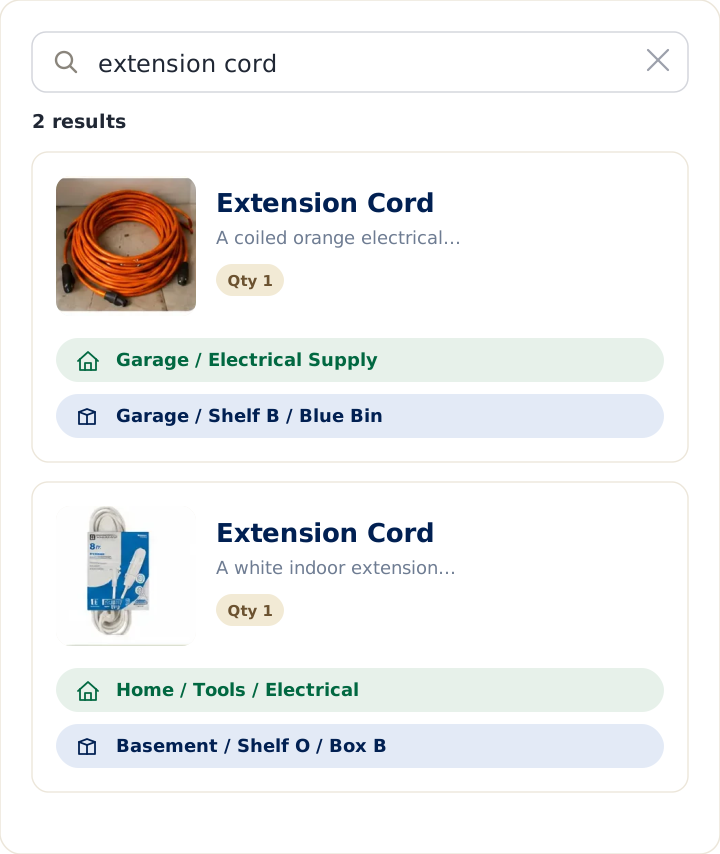
People rarely lose things because they don't own them. They lose them because they can't remember where they put them. The spare HDMI cable, the good scissors, the box of holiday lights, the second set of allen keys you bought because you couldn't find the first — they're all still in your home. Somewhere. The problem isn't ownership. It's remembering where you put things.
If you've tried to solve that with a spreadsheet, you're in good company. Excel is one of the most common tools people reach for when they decide to finally get organized and track their household items. It's powerful, it's familiar, and it's already on your computer. But a lot of those spreadsheets end up abandoned three tabs deep in a folder no one opens again.
This article compares using Excel as a home inventory against LivingLedger, a household inventory app built around one job: helping you find things you already own by remembering where you put them. Along the way it also covers how to track household items well in any tool — what to record, how specific your locations should be, and the mistakes that quietly sink most systems. The goal isn't to talk you out of Excel. For some people it's genuinely the right tool. It's to help you decide which approach will actually get you to "found it" the next time you're standing in the garage, wondering.
If you want the general case for spreadsheets, the spreadsheet-vs-app overview is the brand-neutral companion, and Google Sheets vs LivingLedger covers the shared-cloud variant. This article focuses on what Excel does uniquely well — analysis, custom fields, offline power — and where those strengths still leave gaps for a home inventory.
Quick answer
Choose Excel if you enjoy building your own system, need custom analysis or insurance totals, or already keep a spreadsheet current.
Choose LivingLedger if your goal is simply finding household items quickly, remembering exactly where they are, and avoiding duplicate purchases with minimal upkeep.
Who each tool is really for
Excel is a spreadsheet program. It can be a home inventory, a budget, a project tracker, a meal plan, or anything else you can fit into rows and columns. That flexibility is its superpower. If you like control, enjoy setting up your own columns and formulas, and don't mind doing the upkeep, a spreadsheet can track household items perfectly well.
LivingLedger is purpose-built for one thing: remembering what you own and exactly where it is. You add an item, tag where you put it, and later you search the item's name to see its location. It's designed for busy households, for people who want to reduce mental load, and for anyone whose honest answer to "where is it?" is usually "I have no idea." It works as a native iOS app and as a web app in modern browsers.
Neither is "better" in the abstract. They're built for different relationships with your stuff. Here's how they actually compare.
Excel vs LivingLedger: side-by-side comparison
| What matters | Excel | LivingLedger |
|---|---|---|
| Getting started | Open a blank sheet; set up your own columns | Install and start adding items right away |
| Finding a specific item | Ctrl+F or filter, on whatever device has the file | Type the item name; see its location in seconds |
| Remembering where things are | Only if you create and maintain a location column | Built in — every item has a location |
| Photos | Awkward to embed and keep tidy | Add a photo per item; snap a shelf to add several at once |
| Adding items quickly | Manual typing, row by row | Type it in, or use an AI photo scan (up to 10 items per photo) |
| Search on your phone | Possible in the mobile spreadsheet app, but fiddly | Designed mobile-first; search from the store aisle |
| Multiple people in the household | Shareable, but everyone needs to know the layout | Shared, consistent structure; less to explain |
| Hundreds or thousands of items | Scales technically, but gets unwieldy to navigate | Built to stay searchable as it grows |
| Ongoing upkeep | You maintain the structure and the data | Add and update as you go; less formatting overhead |
| Cost | Free with Google Sheets; included if you have Office | Free plan available. Pro unlocks unlimited AI scanning for personal household use, subject to fair-use limits. |
| Best use case | A DIY tracker you fully control | Finding everyday household items fast, with little effort |
A few of these deserve a closer, honest look — in both directions.
The genuine strengths of Excel
Excel earns its popularity. If you're already tracking household items in a spreadsheet and it's working, these are the reasons why.
- It's free or already paid for. Google Sheets is free, and most people with a computer already have access to Excel. There's no new subscription to evaluate.
- It's endlessly flexible. You can add any column you want — purchase date, price, warranty expiration, serial number, room, who it belongs to. If you have a specific way you think about your belongings, a spreadsheet bends to fit it.
- It's sortable and filterable. Want to see everything in the basement, or every item over $100, or everything you bought last year? A few clicks and it's sorted. Power users love this, and it's a real advantage.
- It's familiar. There's no learning curve for most people. You already know how to type into a cell and hit Ctrl+F.
- You own the file. It's yours, on your drive, in a format you can open anywhere and keep forever.
- It's great for analysis. If your real goal is to add up the value of what you own, or build an insurance list with totals, spreadsheets are excellent at math.
If that list describes how you like to work, Excel may be all you need. The honest truth is that a well-kept spreadsheet beats a half-used app every time.
How to build a good home inventory spreadsheet
If you decide a spreadsheet is your tool, build it so it survives past week one. A few principles make the difference between a sheet you trust and one you abandon:
- One item per row. Resist the urge to lump "kitchen drawer stuff" into a single line. The whole point is to find one specific thing later.
- Keep columns minimal at first. Item name, location, and a notes field will carry you a long way. You can always add value, purchase date, or warranty columns later if you actually use them. Over-engineered sheets are the ones that get abandoned.
- Make location a required habit, not an optional column. Never add an item without filling in where it is. An item with no location is just a fact you already knew — that you own it.
- Use a consistent naming pattern. Decide on something like Room → Zone → Container and stick to it. "Garage shelf," "garage, shelf B," and "the big shelf" will not sort together, and inconsistency is what makes search fail.
- Put the file where you'll actually open it. A sheet buried on a desktop you only touch on weekends won't help you in a store. Cloud storage that syncs to your phone is the bare minimum.
- Update at the moment you move something, not "later." Later never comes, and that's how sheets go stale.
This is genuinely good advice whether or not you ever use an app. The reason these rules are hard to follow isn't that people are lazy — it's that each one adds a little friction, and friction is what real life erodes.
What information should every home inventory include?
Whatever tool you use, a useful household inventory comes down to a short list of fields. Most people overthink this.
- What it is. A name specific enough to search — "20V drill," not just "tool."
- Where it is. The single most valuable field, and the one most people skip or keep too vague. This is what turns a list of things you own into a map of where they are.
- A photo or visual cue. Optional in a spreadsheet, but powerful: it's faster to recognize a picture than to read a description, and it settles "is this the one?" questions instantly.
- Quantity. Useful for consumables and for the duplicate question — knowing you own three already changes what you buy.
- Value, purchase date, or warranty (optional). Worth adding only if your goal includes insurance documentation or analysis. If your goal is simply finding things, these fields are nice-to-have, not need-to-have.
Notice the hierarchy: name and location do almost all the work. Everything else is for specific goals like insurance or budgeting. If you find yourself maintaining ten columns and still can't find your Christmas lights, you've optimized the wrong thing.
How detailed should your locations be?
This is where most home inventories live or die. The rule of thumb: a location should be specific enough to find the item in one trip, without opening anything you don't have to.
"Garage" is a room, not a location — you'll still be opening every bin. "Garage → Shelf B → Holiday bin" is an answer. A good location usually has three parts: the room, the zone within it, and the container. That's why LivingLedger lets locations nest up to three levels deep — Garage → Cabinet → Bin 2, or Kitchen → Pantry → Top Shelf — so the answer is precise enough to walk straight to.
You don't need that much detail for everything. A couch lives in the living room and isn't going anywhere. But for the things you actually lose — the small, portable, seasonal, or rarely-used items that migrate between bins — specificity is the entire value. The shift that makes the difference is mental: you stop trying to remember the container and start trusting the system to remember it for you. You search the item, not the box.
Why searching works better than labeling
Many inventory systems begin with containers. They ask you to label a box, then record what's inside it. LivingLedger reverses that workflow. You start with the thing you're trying to find. Instead of remembering which storage box contains the camping lantern, you simply search for "camping lantern," and LivingLedger tells you which box to open. The item becomes the starting point—not the container.
Where spreadsheets tend to break down
The trouble usually isn't that Excel can't do the job. It's that the job quietly stops getting done. Across people who've tried it, the same pattern shows up:
- Manual entry is slow, so it gets abandoned. Typing in every item, row by row, is tedious. Many people describe spending "a few days" on the initial list and then never touching it again. An inventory you stopped updating can't tell you where anything is.
- It goes stale the moment you move something. The day you shuffle a bin from the closet to the garage, the spreadsheet is wrong — and there's no nudge reminding you to fix it. Out-of-date entries are worse than none, because you can't tell which ones to trust.
- It's not really in your pocket. Picture yourself standing in the paint aisle at Home Depot, trying to remember if you already own a usable roller. Spreadsheets technically open on phones, but editing tiny cells and finding the current file is enough friction that most people don't check. So they buy a second roller — the exact thing they were trying to avoid.
- Locations are an afterthought. A spreadsheet only remembers where things are if you build a location column and fill it in faithfully. Most people don't, or they write "garage" and stop there, which isn't specific enough to actually find anything.
- Photos are clumsy. You can embed images in cells, but it's awkward, it bloats the file, and it rarely stays organized.
None of this makes Excel a bad tool. It makes it a tool that rewards discipline. If your discipline runs out — and for most busy households it does — the spreadsheet runs out with it.
Common mistakes when tracking household items
These show up no matter which tool you choose, and they're worth naming because avoiding them matters more than the tool itself:
- Trying to inventory the whole house at once. This is the fastest road to burnout. Start with one shelf, or just the twenty things you're always hunting for.
- Vague locations. "Basement" is not findable. If a location wouldn't let a houseguest find the item, it's too vague.
- Letting it go stale. A system you don't update becomes a system you don't trust, and a system you don't trust is one you stop checking.
- Choosing a tool that isn't with you when you need it. The moment you need the answer is usually in a store or a closet, phone in hand — not at a desk. If your inventory can't answer you there, it can't prevent the duplicate purchase or end the search.
- Over-engineering. Twelve columns, color-coding, and formulas feel productive, but they raise the cost of every single entry. The more effort each item takes, the sooner you quit.
The genuine strengths of LivingLedger
LivingLedger is narrower than Excel on purpose. It doesn't try to be a budget or a database. It tries to make sure that when you need something, you can find it. The value shows up in outcomes, not features.
LivingLedger doesn't replace your memory because your memory is bad. It replaces it because modern homes contain hundreds or thousands of objects, and no one can reliably remember where all of them are. Instead of trying harder to remember, you look it up. You search the item, not the box.
- A searchable memory for your home. Instead of remembering where you put the camping lantern, you remember that LivingLedger knows. Type "lantern," see "Garage → Shelf B," and go straight to it. You search the item, not the box.
- Exact storage locations, not vague ones. Locations nest up to three levels deep, so the answer is precise enough to walk to, not just a room to start rummaging in.
- Adding items takes seconds. You can type an item in, or take a photo and let the app suggest what it sees. One AI photo scan can identify up to 10 items at once — a shelf, a drawer, a bin, a cabinet, or a single object — and you review what it finds, adjust anything, and save. The free plan includes 50 lifetime AI scan credits, with one credit per photo scan, and manual entry is always unlimited.
- It reduces mental load. This is the quiet benefit. You stop carrying the map of your whole house in your head. That mental space matters for busy households and is part of why LivingLedger works well for ADHD-friendly organization, where "out of sight, out of mind" is a daily reality.
- It helps you avoid buying duplicates. You're standing in Home Depot looking at another extension cord. You hesitate because you think you already own one — but you aren't sure. You search "extension cord" and see "Garage → Shelf B → Blue Bin." You put the new one back.
- It stays usable as it grows. Whether you're tracking a single closet or your whole home, search keeps the list manageable. You don't have to scroll; you ask.
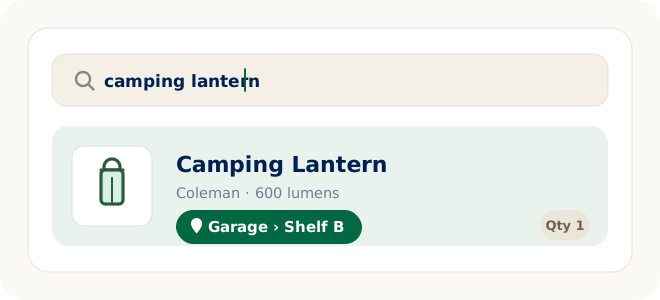
Notice that AI photo scanning is on this list, but it isn't the headline. The photo feature is just the fastest way to get items in. The actual value is finding them later.
And here's the part worth saying plainly: the goal isn't to build a perfect catalog of everything you own. Nobody wins a prize for the most complete spreadsheet. The goal is to stop losing Saturday afternoons opening every storage bin looking for one thing you know you bought. It's to find the Christmas lights the night before guests arrive, instead of tearing the attic apart at 11pm. The goal isn't inventory. The goal is confidence. Confidence that if you own something, you can find it.
Who should choose Excel
Be honest with yourself about how you work. Excel is the better choice if:
- You genuinely enjoy building and maintaining your own system, and you'll keep it up.
- Your main goal is analysis — totaling up value, building an insurance schedule, or running calculations on what you own.
- You need highly custom fields and complex sorting that a focused app intentionally keeps simple.
- You're tracking a small, stable set of items that rarely move, so staleness isn't a real risk.
- You want a single file you fully control and can keep in your own storage indefinitely.
- You already have a spreadsheet that works and you're happy with it. If it's not broken, don't replace it.
For DIY power users who like control, a spreadsheet is a perfectly respectable home inventory. There's no shame in a tool that's free and familiar.
Who should choose LivingLedger
LivingLedger is likely the better fit if:
- Your honest problem is finding things, not analyzing them — you own it, you just can't remember where it is.
- You've started a spreadsheet (or three) and abandoned it because the upkeep wasn't worth it.
- You want to organize household items without setting up columns, formulas, or a system first.
- You need answers on your phone, in the moment — in the garage, the attic, or the store.
- You're tired of buying duplicates of things you already own.
- You're managing a busy household and want to reduce the mental load of remembering where everything lives.
- You want exact locations — the specific shelf or bin — not just a room.
If the words "I know we have one, I just can't find it" come out of your mouth regularly, that's the problem LivingLedger is built to end.
A note on cost and availability
LivingLedger has a free plan with unlimited manual items and 50 lifetime AI scan credits, so you can track your whole home by hand at no cost and use photo scanning when it saves you time. Pro unlocks unlimited AI scanning for personal household use, subject to fair-use limits. It's available as a native iOS app through the Apple App Store and as a web app in modern browsers, including iOS Safari, Android Chrome, and desktop Chrome and Edge.
Excel, by comparison, is free in the form of Google Sheets, or included if you already have a Microsoft Office subscription. For straightforward cost, a spreadsheet is hard to beat — the real "cost" of a spreadsheet is the time and discipline to keep it current.
Frequently asked questions
Can I use Excel as a home inventory?
Yes. Excel can absolutely work as a household inventory, especially if you build a clear structure with columns for the item, its location, a photo or note, and anything else you care about. The catch is upkeep: a spreadsheet only helps you find things if you keep it current and specific. If you'll maintain it, it's a capable, free home inventory. If past spreadsheets have ended up abandoned, that's a sign the friction is too high for how you actually live.
Is a spreadsheet good for tracking where things are?
It can be, but only if you create a dedicated location field and fill it in for every item — and keep it updated when things move. Most people start strong and then let it drift. A purpose-built home inventory app makes the location a required, central part of every item, so "where is it?" is always answerable.
What's the easiest way to remember where things are at home?
The easiest system is the one you'll actually keep using. That usually means low effort to add items, search you can do from your phone, and a clear place to record the exact location. Whether that's a tidy spreadsheet or a dedicated app depends on you — but the deciding factor is almost always how little effort it takes to stay current.
Should I use a spreadsheet or a home inventory app?
Choose a spreadsheet if you like building your own system, you mostly need analysis or totals, or your item list is small and stable. Choose a household inventory app if your real goal is finding everyday items quickly, you want it on your phone, and you've struggled to keep a spreadsheet up to date. Many people who switch do so not because the spreadsheet failed at storing data, but because it failed at being there when they needed an answer.
Does LivingLedger require me to type in everything by hand?
No. You can type items in manually — that's unlimited on every plan — or you can take a photo and let the app identify what it sees, up to 10 items per photo. You review the results, adjust anything, and save. That's the main reason people who bounced off manual spreadsheet entry tend to stick with it.
Can I move my existing spreadsheet into LivingLedger?
There's no one-click spreadsheet import today, so the practical approach is to start with the items you actually look for most and add them as you go — often it's faster to photograph a shelf than to re-type old rows. Many people find they never needed most of their old spreadsheet anyway; they needed the twenty things they keep losing.
Is LivingLedger free?
There's a free plan with unlimited manual items and 50 lifetime AI scan credits. You can run a complete home inventory on the free plan by adding items manually. Pro unlocks unlimited AI scanning for personal household use, subject to fair-use limits, and your saved items remain available even if you stop paying for Pro.
Will a home inventory really stop me from buying duplicates?
It helps, because it puts the answer in your pocket. The reason people rebuy things isn't carelessness — it's that the list, if it exists, isn't with them at the store. When you can search "extension cord" from the aisle and see that you already own two in Garage → Shelf B, the duplicate purchase simply doesn't happen.
Related comparisons
Still weighing your options? These companion guides look at the other tools people use to keep track of household items:
- Home inventory spreadsheet vs. app — the general, brand-neutral case behind this article
- Google Sheets vs. LivingLedger — the same comparison for cloud spreadsheet users
- Apple Notes vs. LivingLedger — for people keeping lists in their phone
- Notion vs. LivingLedger — for people building their own system from a template
- Notebook vs. LivingLedger — the pen-and-paper starting point
- Sortly vs. LivingLedger — for those considering a dedicated inventory app
Thinking of switching?
Don't rebuild your entire home in one weekend. Start with the 20 or so items you search for most often, and add the rest naturally as you use them. Starting small is the whole point — a calm system you actually keep beats a complete one you abandon.
The honest recommendation
If you have a spreadsheet that works and you keep it current, keep using it. Excel is free, flexible, and genuinely good at what it does, especially analysis and custom tracking. There's no reason to switch tools just to switch tools.
But if you recognize the more common story — a spreadsheet started with good intentions and quietly abandoned, while you keep losing track of things you definitely own — the issue probably isn't your discipline. It's that the tool asked for more upkeep than real life allows. That's the gap LivingLedger is designed to close: less effort to add things, locations built into every item, and search that lives on your phone for the moment you actually need it.
You already own it. You just can't find it.
So before you switch anything, try a quick experiment: think of the last five things you went looking for in your home. If you can say exactly where each one is right now, your system is working — keep it. If you can't, that's precisely the problem LivingLedger is built to solve.
Start free No credit card required.